
How retractable awnings actually work, and what the wind rating means
Everything worth knowing about a retractable awning is in the arms. They are what hold the fabric flat without any front posts, what fail if the awning is left out in a gale, and what the price difference between two similar looking products usually reflects. Understand the mechanism and the specification sheet stops being marketing and starts being useful.
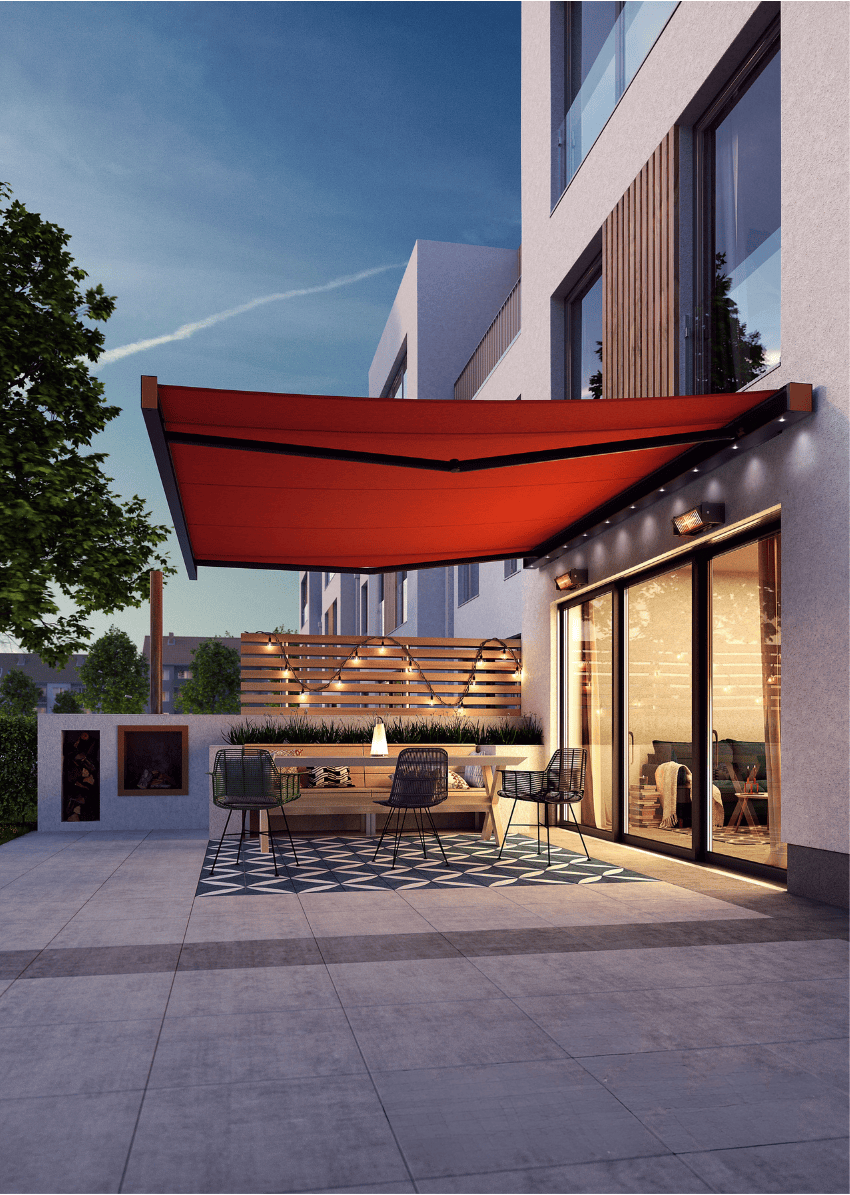
The folding arm principle
Each arm is a jointed lever under constant spring or gas tension. As the roller turns, the arms straighten and pull the fabric taut; as it reverses, they fold back against the wall. The tension is what keeps the fabric flat without a front frame, and it is why an awning feels rigid despite having nothing supporting its leading edge. Better arms use stronger internal cabling or chain and larger joints, which is where cost sits.
Roller, tube and drive
The fabric wraps a steel tube containing a tubular motor, or a gearbox on manual versions. The tube diameter has to suit the fabric length, because too much fabric on too small a tube gives an uneven roll and creasing. Motors have built in limits set at installation so the awning stops at the right point every time, and they are sealed units rather than serviceable parts.
Wind ratings, in plain terms
Awnings carry a wind resistance class based on standard testing. Most quality domestic patio awnings sit in the middle classes, which corresponds to a fresh breeze rather than a storm. No retractable awning is a structure for windy weather, because the whole design depends on unsupported arms. Treat the rating as the point at which it should be retracted, not as a challenge.
If your patio is genuinely exposed, a fixed veranda or louvred roof is the product that stays out when the weather turns.
Sensors and automation
A wind sensor mounted on the leading edge or the wall retracts the awning automatically when vibration or wind speed passes a threshold, and it is the single most valuable accessory because most damage happens when the house is empty. Sun sensors extend the awning when brightness is sustained, which is convenient but occasionally unwanted. Rain sensors matter more on shallower pitches where pooling is a risk.
- Wind sensor, protective, strongly recommended on open sites
- Sun sensor, convenience, easy to override
- Rain sensor, prevents pooling on shallow pitches
- Handset or app control, timers and multiple awnings from one point
Where retractable wins and where it does not
Retractable gives you the choice of full sun or full shade in twenty seconds, costs less than a glazed structure and adds nothing permanent to the house. It does not give you rain cover you can rely on, it does not stay out in wind, and it does nothing in winter. If your complaint is summer heat, it is the right product. If your complaint is that you cannot use the patio in April or October, it is not.
Lighting, heating and side screens
LED strips can be built into the cassette or arms, and infrared heaters can be mounted on the wall beneath. Drop down side screens on vertical guides deal with low sun from the side and add a degree of privacy. All of these need the electrical supply thought about at survey rather than found afterwards.
Questions people ask us about this
How long does a retractable awning take to open?
A motorised patio awning typically extends fully in under half a minute, and you can stop it at any point for partial shade.
What wind speed can an awning handle?
It depends on the tested class of the specific model, but domestic patio awnings are designed for breezes rather than strong winds and should be retracted as conditions build. A wind sensor does this for you.
Can it be left out overnight?
In settled weather, yes, though we would still retract it. Wet fabric left rolled for long periods is the bigger issue, so let it dry before closing.
What happens in a power cut?
Most motorised awnings accept a manual override crank so you can retract them without power. Ask for one to be supplied if it is not included.
Are side screens available?
Yes, drop down vertical screens can be added to deal with low sun and wind from the side, and they are neatest when specified at the same time as the awning.
In short
Retractable awnings rely on tensioned folding arms, which is why they excel at sun control and are not built for wind. Sensors protect them, and the wind class tells you when to bring them in.
Not sure whether retractable is the right answer?
Tell us when you want to use the patio and how exposed it is. We fit awnings, verandas and louvred roofs, so the recommendation follows the garden.