
How a louvred roof actually works, blade by blade
We had an enquiry this week from someone who had watched a louvred roof close in the rain at a restaurant and wanted to know whether the same thing would work on a north facing patio in a Yorkshire village. Fair question. An opening roof is the most mechanical thing we install, and understanding what the blades, the motor and the drainage are doing makes it much easier to decide whether the extra cost is worth it for you.
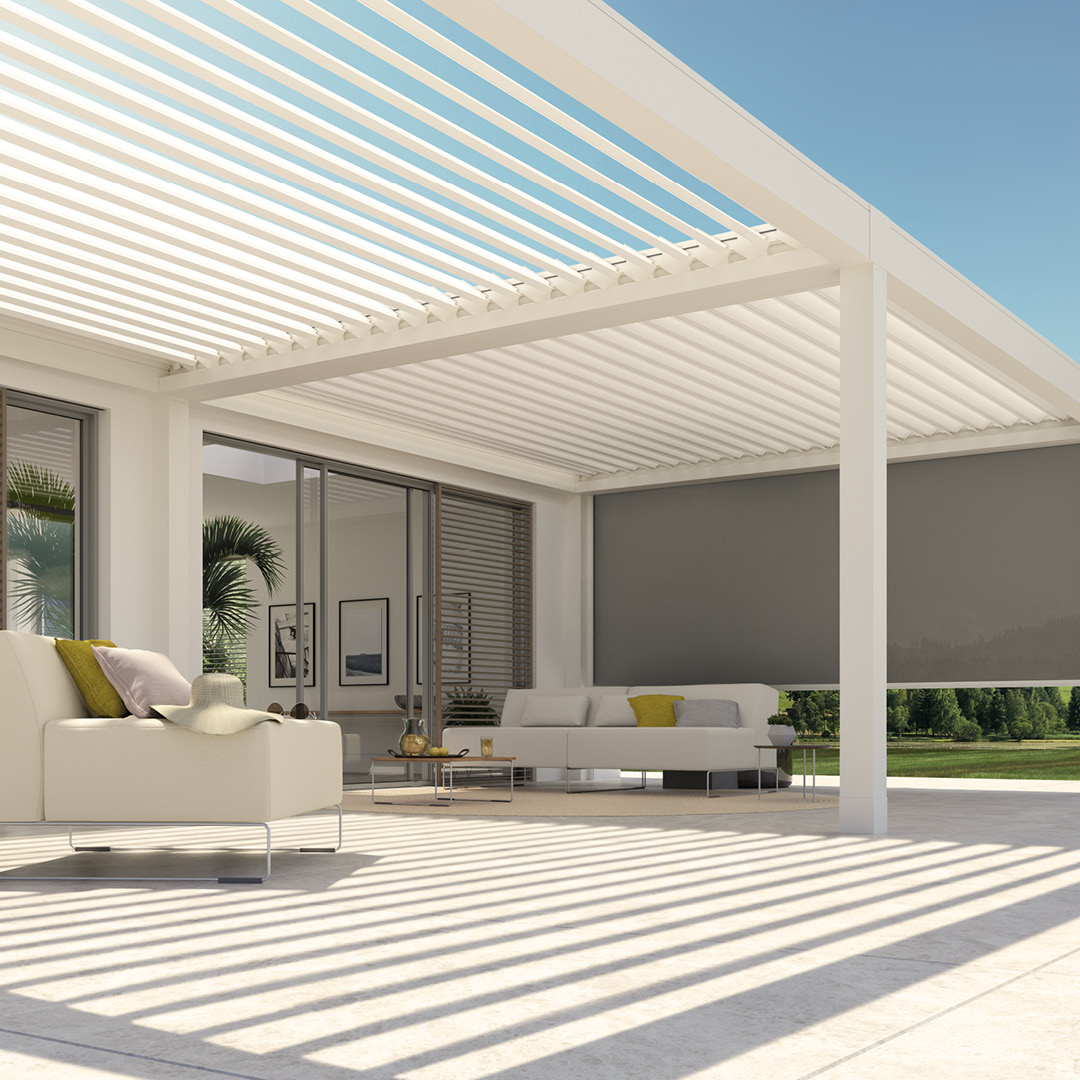
The mechanism, in plain terms
Each blade is an extruded aluminium aerofoil with a channel along its lower edge. The blades sit on pivots and are linked by a drive bar, so a single motor turns all of them together. Rotation is smooth and slow by design, because the mechanism is engineered for tens of thousands of cycles rather than speed. When the blades reach the closed position they overlap along their long edges, which is what turns a set of slats into a roof.
Where the rain goes
This is the part most people underestimate. Water landing on closed blades runs along the blade channel, empties into a collecting gutter integrated in the frame beam, then drops through the inside of a post into your existing drainage or a soakaway. Nothing is bolted on and nothing hangs below the roofline. If a survey finds nowhere sensible for that water to go, the drainage becomes part of the job rather than an afterthought.
Wind driven rain can still angle in from the open sides. If the patio is exposed on the prevailing side, price zip screens at the same time.
Sun, shade and the angle in between
The setting people use most is not open or closed, it is somewhere around 30 to 45 degrees. At that angle you get shade on the table, air still moving through, and the sky visible from a seat. On a hot afternoon that is a more comfortable place to sit than under fixed glass, which is the strongest argument for louvres over a veranda roof.
Controls, sensors and what happens when you are out
Standard control is a handset, with app control available on most systems. A rain sensor closes the blades automatically, which matters if you leave cushions out or if the roof also shelters a doorway. On exposed sites a wind sensor can move the roof to a safe position in a gust. Set the presets during handover, because the settings people actually use are usually two or three positions, not a slider.
- Handset for daily use, wall switch as a backup
- Rain sensor closing the roof while you are at work
- Scene presets for dining, shade and full sky
- Manual override so the roof can be moved if power is lost
See an opening roof move before you commit
We can talk you through blade positions, drainage routes and sensor options against your own patio layout, then price it properly after a measure.
Snow, winter and the sensible position
Louvred roofs are engineered for snow load in the closed position, and the correct winter setting is closed rather than open or part angled, so the frame carries the load as designed. Clearing heavy settled snow rather than letting it build is good practice on any garden structure, whether the roof is glass, solid or louvred.
Servicing an opening roof
There are moving parts, so there is a small amount of upkeep that a fixed roof does not need. Once a year, brush the blade channels clear of leaf litter and grit, check that the drive runs without a catch, and clean the sensor lens so it is not fooled by dust. Motors are sealed units and are not user serviceable, which is why manufacturer terms matter alongside our workmanship guarantee.
Is it worth the premium over glass?
If you want a bright kitchen, a glass veranda gives more daylight for less money. If you want a patio you can tune through the day, and you like the idea of sitting under open sky at eight in the evening and closing the roof at nine when it turns, the louvred roof earns its cost. That is the honest split, and it is the question we ask first at survey.
Questions people ask us about this
Do the blades leak where they overlap?
A properly aligned closed roof sheds water along the blade channels into the frame gutter. Leaks are almost always a levelling or debris problem rather than a design one, which is why setting out matters at installation.
Can I leave the roof open all summer?
Yes. Many owners leave it open and only close it when the sensor tells it to. The mechanism is cycle tested by the manufacturer for repeated use.
How much daylight reaches the house when the roof is closed?
Very little through the roof itself, because a closed louvred roof is solid. If daylight into the room behind is the priority, glass is the better roof.
What happens in a power cut?
The roof stays where it is, and systems include a way to move the blades manually so you are never stuck with a roof open in bad weather.
Are louvred pergolas noisy when they move?
There is a low motor hum for the few seconds the blades rotate. It is quieter than a garage door and stops as soon as the roof reaches position.
Do you fit these, or only verandas?
Louvred pergolas are one of our installed products, alongside verandas, glass rooms, awnings and carports.
In short
A louvred roof is a mechanical roof: blades rotate, overlap, and drain through the frame. Buy it for control through the day, not for daylight into the house.