
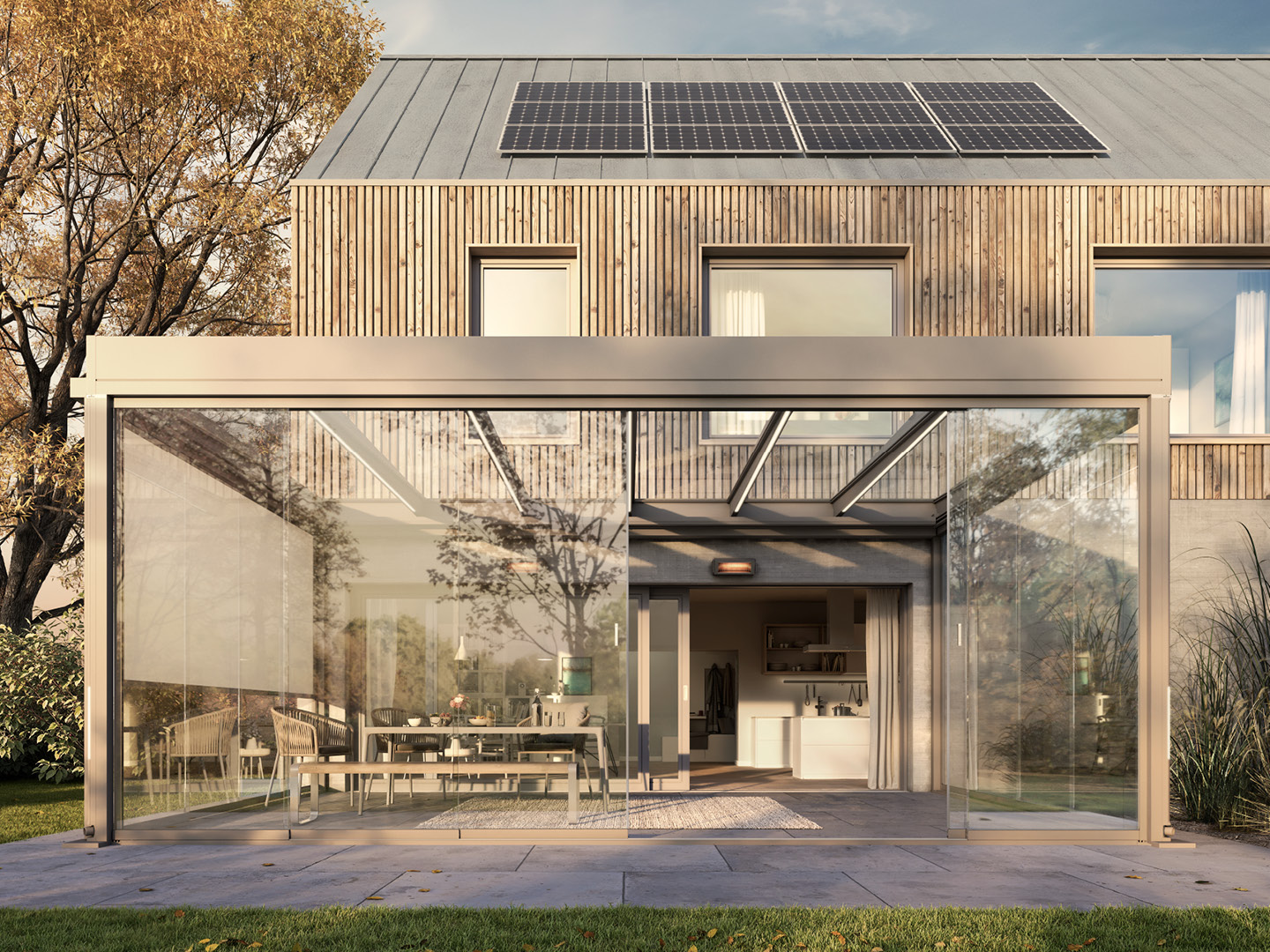
Managing Solar Gain Beneath a Glass Roof
A glass roof turns a patio into a genuinely usable room for much of the year, but the same transparency that lets in light also lets in short-wave solar radiation that converts to heat once it strikes surfaces beneath the roof. Understanding that conversion process is the starting point for choosing coatings, ventilation and shading that actually work together.
The greenhouse mechanism in a garden setting
Sunlight arrives as short-wave radiation that passes through glass with relatively little absorption. Once it strikes furniture, decking or paving beneath the roof, that energy is re-radiated as long-wave infrared, which glass is far less transparent to. The result is heat becoming trapped in the space rather than escaping back out through the roof it entered by, the same basic mechanism that warms a car interior on a sunny day, scaled up to a veranda or glass room.
What a coating actually changes at the glass surface
A solar-control coating applied to glass is engineered to reflect or absorb a portion of the incoming short-wave radiation before it ever reaches the interior, rather than trying to manage heat after it has already entered the space. Coatings vary in how much visible light they let through versus how much solar energy they block, so a specification decision involves balancing brightness against heat reduction rather than assuming more coating is automatically better.
Why glazing coatings alone rarely solve overheating completely
Even a well-specified solar-control coating typically reduces rather than eliminates solar gain, because some portion of incoming energy always converts to heat at the surfaces it strikes. This is why coatings are best understood as one layer of a wider strategy rather than a stand-alone fix, working alongside ventilation and shading rather than instead of them.
Building a ventilation strategy around airflow, not just openings
Hot air rises and collects at the highest point of an enclosed roof space, so a vent positioned near the roof's apex or ridge clears heat more effectively than an opening at a lower level alone. Cross-ventilation, where cooler air can enter at a lower point on one side while warm air escapes higher on another, moves heat out actively rather than relying on it to dissipate passively.
- Position vents near the highest point of the roof structure
- Pair a low-level opening with a high-level one for cross-flow
- Avoid fully sealing every elevation of an enclosed glass room
- Consider a roof section that opens rather than fixed glazing only
External shading intercepts heat before it becomes a problem
Shading fitted outside the glass, such as a retractable fabric layer or louvred blades above the glazing, blocks solar radiation before it reaches the glass surface at all, which is fundamentally more effective than any internal treatment. Once sunlight has passed through glass and converted to heat inside the space, an internal blind can only address glare and direct light, not the heat that has already been trapped.
- External louvres or a fabric layer intercept heat before the glass
- Internal blinds reduce glare but not trapped heat
- Automated external shading can respond to a sun sensor through the day
- Orientation of the shading matters as much as the material chosen
Laying out airflow through the space itself
Beyond the roof and shading, how furniture and any glass wall panels are arranged affects how freely warm air can circulate and escape rather than pooling in a still corner. Leaving a clear path between a low-level opening and a higher vent, rather than blocking it with tall furniture or dense planting, helps the ventilation strategy work as intended rather than existing on paper only.
Combining the layers into one working system
The most effective approach treats coating, external shading and ventilation as three interacting layers rather than competing options: the coating reduces the energy entering in the first place, external shading intercepts the remainder before it reaches the glass, and ventilation clears whatever heat still accumulates, each layer picking up where the previous one leaves off.
Common questions
Will a solar-control coating alone stop my glass room overheating?
It will reduce solar gain meaningfully, but it works best combined with ventilation and external shading rather than relied on as a complete solution by itself.
Why is external shading considered more effective than an internal blind?
External shading blocks solar radiation before it reaches the glass and converts to heat inside, whereas an internal blind can only manage light and glare once that heat is already trapped in the space.
Where should roof vents be positioned for the best effect?
Near the highest point of the roof, ideally paired with a lower-level opening elsewhere so warm air can be drawn out through genuine cross-flow rather than sitting stagnant.
Does furniture arrangement really affect how warm a space feels?
Yes, blocking the path between a ventilation opening and a high-level vent with tall furniture or dense planting reduces how effectively warm air can actually clear the space.
Is tinted glass the same thing as a solar-control coating?
They achieve a related result but through different means; a tint changes the glass's visible appearance and light transmission, while a coating is engineered specifically around reflecting solar energy, and the two are sometimes combined.
Can I retrofit external shading onto an existing glass roof?
In many cases a retractable fabric layer or louvred addition can be fitted to an existing structure, though the specifics depend on the existing frame, so it's worth having the structure assessed.
In short
Overheating under a glass roof is best tackled with three layers working together: a solar-control coating at the glass, external shading intercepting the remainder, and ventilation clearing residual heat.
What to do next
Ask us to design a combined coating, shading and ventilation strategy for your glass roof space.
Ready to Transform Your Outdoor Space?
Get a free, no-obligation quote. Email a photo of the area plus your preferred width, projection and operation type, and we'll do the rest.