
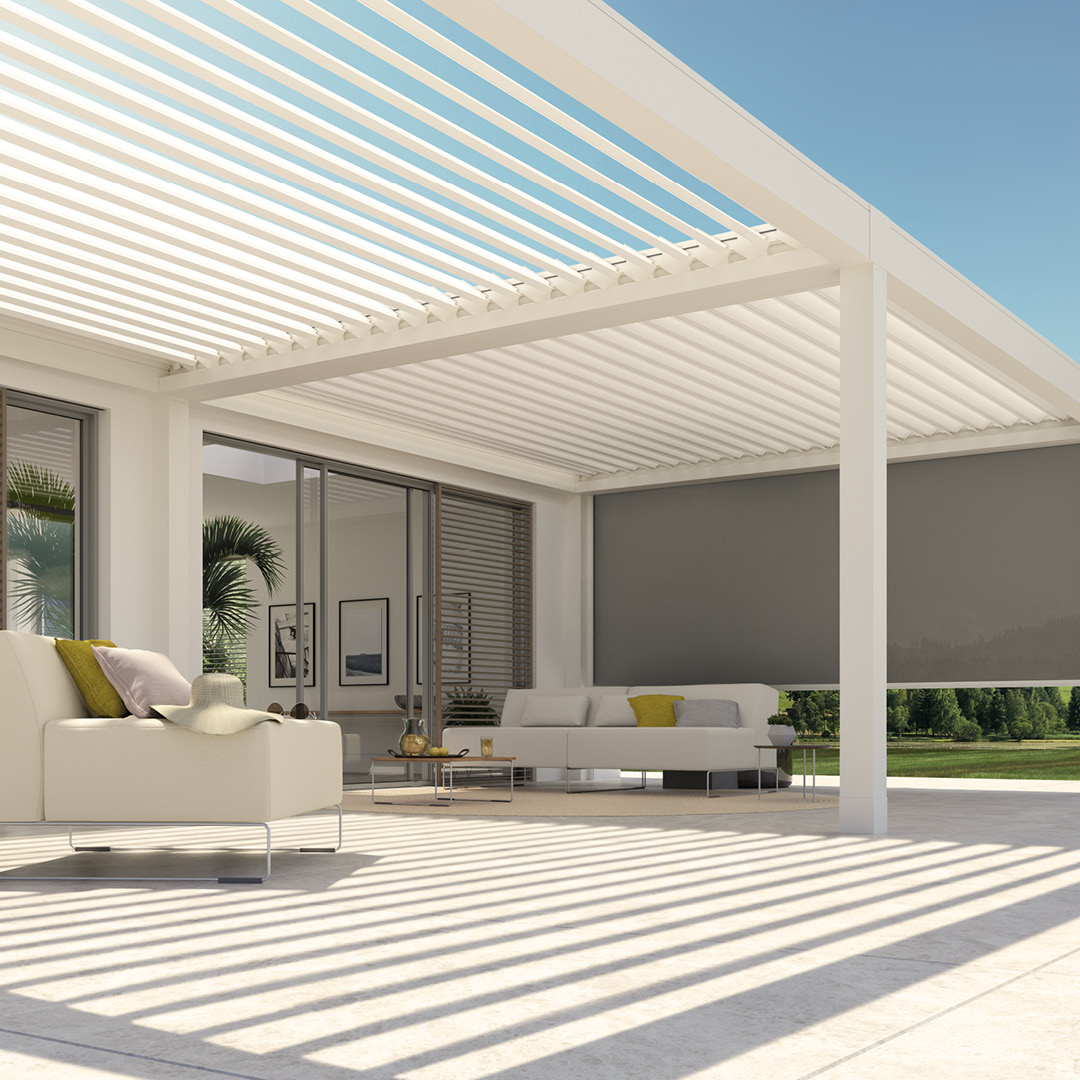
Adjustable Louvres Against a Permanent Fixed Slat Design
A louvred roof adjusts by hand or motor to open and close the slats; a fixed slatted roof stays in one position year-round. Both create dappled shade, but they ask different things of the installer and the homeowner. This technical breakdown explains how each actually works and where each earns its place.
The Mechanical Reality of Adjustable Louvres
A louvred roof has individual blades or slats connected to a mechanical system that rotates them. That rotation is powered either by hand crank (you adjust the angle manually) or by electric motor with remote control or sensors. When the blades rotate, they change the amount of light and rain that pass through. Closed fully, they block most rain and sun; open fully, they let both through; halfway, they create dappled shade while still shedding some rain. The system needs regular attention: the mechanical linkages need to stay free of debris, the seals need checking, and if it's motorised, the motor and wiring are additional components that can fail.
Fixed Slatted Design: Static, Durable, No Moving Parts
A fixed slatted roof is simply timber or aluminium slats spaced at a fixed angle, bolted in place permanently. There are no moving parts, no motors, no seals to fail. The angle is chosen when the roof is designed, perhaps 45 degrees for dappled summer shade, and it stays that way. Rain passes through the gaps (dripping directly onto a seating area below) or runs off the slats depending on the angle. Wind can't damage moving parts because there aren't any. Cleaning is straightforward: a hose or brush clears debris off the static slats. The trade-off is that you can't adjust it for different seasons or different weather patterns, the shade is what it is every day of the year.
How Each Handles Rain and Drainage Across the Year
A closed louvred roof, when the blades are horizontal, sheds rain outward like a solid roof. Open, the slats let rain through. Fixed slats, set at 45 degrees, let rain through the gaps and drip onto whatever is below, or if angled steeply enough, they channel water down the slats themselves. In a wet Yorkshire autumn, a closed louvred roof keeps you and the seating area dry. A fixed slatted roof in the same conditions creates a dripping dapple, fine for a pergola over a patio (water runs off) but not ideal if you're trying to keep a dining area dry. This is why fixed slats are often preferred over pergolas (where water is acceptable) and louvres are preferred when you need actual cover.
- Louvred: fully closed = waterproof, fully open = dappled and wet
- Fixed slats: water passes through regardless of angle
- Louvred: requires guttering on the closed side
- Fixed slats: drainage is passive and always visible
Operational Effort: Motor, Manual and Seasonal Adjusting
A louvred roof motorised with a remote is convenient: one button press opens or closes the whole roof. But that convenience has maintenance attached. Motors need power (hardwired electrics or solar panels), relays and switches can corrode in damp air, and if the motor jams (often because slats have collected debris), you might not be able to open or close the roof until someone comes to fix it. Manual hand-crank louvres need the same debris vigilance but put the work on you, several turns of a crank each time you want to adjust. A fixed slatted roof requires none of this: you never adjust it. The choice is whether convenience (motorised louvre) outweighs reliability and low upkeep (fixed slats).
Long-Term Durability and Maintenance Rhythm
Fixed slatted roofs, being static, rarely wear out unless wood rots (which takes years of standing water and poor drainage) or fixings corrode. Cleaning is periodic, hose it off once or twice a year. Louvred roofs, because of the moving parts and seals, need more attention. Inspect the blade seals annually, check that blades move freely, clear debris from the guide tracks, and if motorised, test the motor seasonally. In a coastal location like Hull, salt air accelerates corrosion of any moving mechanism; fixed slats, though still needing checking, are simpler to maintain. Neither option is high-maintenance in absolute terms, but a louvre demands more regular inspection to stay reliable.
Choosing Between Control and Simplicity
If you value the ability to adjust shade and weather throughout the day or between seasons, a louvred roof rewards that engagement. You can open it in spring to let morning sun through, close it during afternoon heat in July, and manage autumn rain. If you prefer to install it, forget about it and clean it occasionally, fixed slats are the answer. The choice isn't about one being objectively better, it's about how engaged you want to be with your outdoor structure day to day. Many gardens would benefit from a hybrid: a fixed slatted pergola over one seating area and a motorised louvre over another, each suited to its use.
Common questions
Can a louvred roof be overridden manually if the motor fails?
Some designs include a manual override; others don't. Check the product specification before ordering. Without an override, a jammed motorised louvre stays in that position until repaired.
Do fixed slats need guttering?
Only if water dripping through the slats lands where you don't want it. Over a pergola-style seating area, water dripping through is acceptable. Over a dining table or deck, you might add guttering below to catch and channel it.
Is a motorised louvre waterproof when closed?
Most designs shed rain when fully closed, but they're not waterproof to the same standard as a solid roof. Some rain sneaks past the blade seals in heavy downpours. If you need true weatherproofing, ask whether the specific model meets that need.
How often do louvred roof motors need servicing?
Annual inspection of the mechanism and seals is sensible, especially before heavy weather seasons. Actual servicing depends on the system; some motorised roofs are sealed units that rarely need attention, others need regular cleaning and lubrication.
Can fixed slats be retrofitted to a louvred frame if the motor fails?
Possibly, but it's rarely practical. The structures are engineered differently. If a louvre motor fails, repair or replacement is usually the better path than wholesale redesign.
In short
Louvred roofs adapt to weather and season; fixed slats stay put and need no moving parts. Choose based on whether you want daily control or low-maintenance simplicity.
What to do next
Deciding whether you want to adjust your roof with the seasons or keep it fixed and simple? We install both systems across Yorkshire, talk through which suits your garden and how you use it.
Ready to Transform Your Outdoor Space?
Get a free, no-obligation quote. Email a photo of the area plus your preferred width, projection and operation type, and we'll do the rest.