
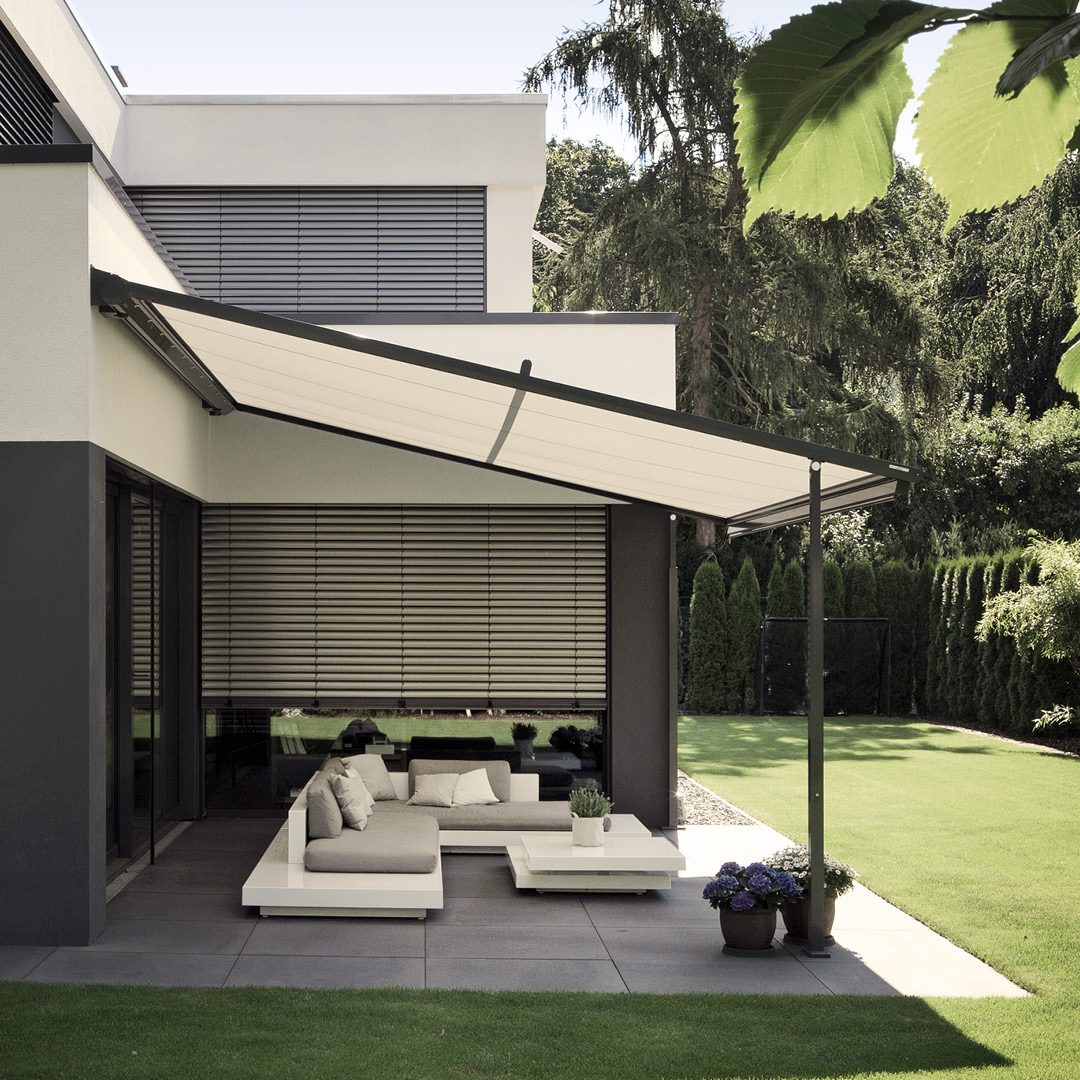
How Motorised Awnings and Roofs Actually Operate
Manual crank operation still exists, but the large majority of awnings, folding-arm systems and louvred veranda roofs installed now run on an electric motor with remote or app control. Understanding what's actually inside that decision helps you choose sensibly rather than just ticking the 'electric' box.
Tubular motors inside the roller
Most electric awnings use a tubular motor fitted inside the roller tube itself, sized to the fabric weight and awning width so it extends and retracts smoothly without straining. Motors are generally rated to a specific maximum width and weight, which is one reason oversized fabric orders need the motor spec checked.
Remote handsets versus wall switches
A simple handheld remote suits most households, while a fixed wall switch offers a permanent control point that doesn't get lost, and the two aren't mutually exclusive on most systems. Some households prefer both fitted for convenience.
App and smart home integration
Many current motor systems can connect to a smartphone app or a home automation hub, allowing scheduled operation or control from indoors without needing the physical remote to hand. This is a genuine convenience feature rather than something that changes how the mechanism itself performs.
- Tubular motor
- sits inside the roller tube, sized to fabric weight
- Handset
- simple, low-cost, easily replaced if lost
- Wall switch
- fixed control point, good for shared households
- App control
- adds scheduling and remote access via smartphone
What happens without power
A power cut leaves a motorised awning or roof in whatever position it was last in until power returns, and most systems don't include manual override as standard. If reliable operation during power cuts genuinely matters to you, it's worth discussing backup options with your installer before ordering.
Integration with sensors
Motors are commonly wired to accept signals from wind and rain sensors, allowing automatic retraction in strong gusts even if nobody is home to operate the remote. This pairing is one of the more genuinely useful upgrades available on a motorised system.
Common questions
Can a manual awning be upgraded to electric later?
Sometimes, depending on the frame and roller tube compatibility, though it's often simpler and more reliable to specify electric operation from the outset.
What happens if the remote gets lost or breaks?
Most systems allow replacement or re-pairing of a new remote to the existing motor, though it's worth checking this with your specific supplier.
Do smart features require ongoing subscription costs?
This varies by manufacturer and app platform, so it's worth asking specifically rather than assuming, as practices differ between brands.
Are motors noisy in operation?
Quality tubular motors are generally quiet in normal operation, though some noise during extension and retraction is normal and expected.
In short
Tubular motors, remotes, app control and wind sensors work together to automate awning and roof operation, with a few real trade-offs to weigh.
What to do next
Ask us to demonstrate remote and app control options before choosing your motor specification.
Ready to Transform Your Outdoor Space?
Get a free, no-obligation quote. Email a photo of the area plus your preferred width, projection and operation type, and we'll do the rest.