
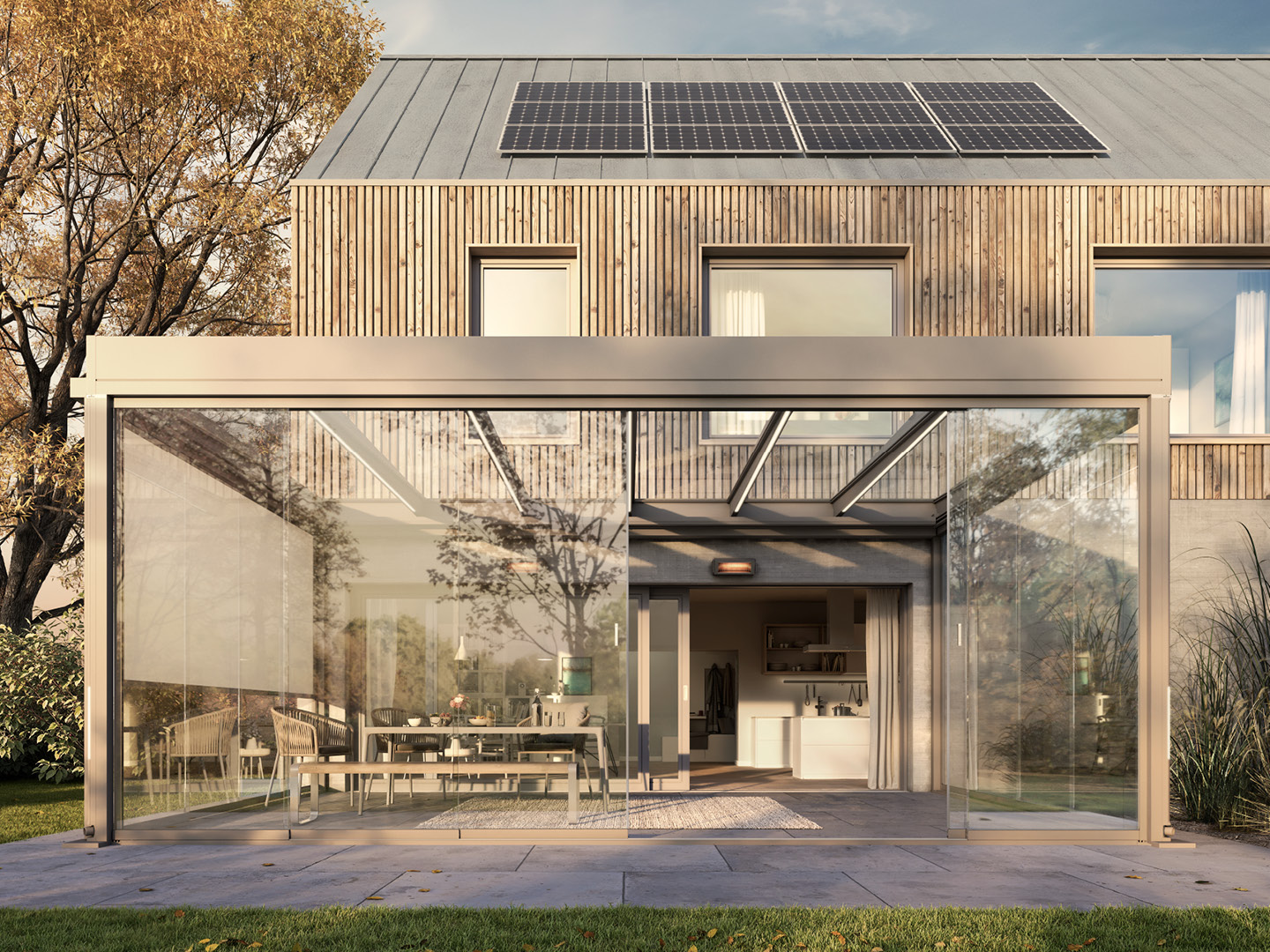
Understanding Toughened Glass as a Veranda Roof Material
Toughened glass is the roof glazing most people picture when they think of a modern veranda: clear, strong and resistant to everyday knocks. It isn't the only option, but it's a sensible starting point for understanding how glass roofs are specified and what changes if you upgrade to laminated.
How toughening changes the glass
Toughened glass is heat-treated so it's several times stronger than standard annealed glass of the same thickness, and if it does break it fractures into small blunt fragments rather than long shards. That's the property that makes it suitable for an overhead application where nobody wants glass falling in large pieces.
- Heated to around 620°C then rapidly cooled
- Fractures into small granular pieces if broken
- Cannot be cut or drilled after toughening
Weight and support implications
Glass is heavier than polycarbonate of a comparable size, which feeds directly into how the frame is engineered. Post spacing, beam depth and fixing points all get sized around the actual roof material chosen, so swapping glass for a lighter panel later isn't simply a case of removing the old sheet.
Where laminated glass fits in
Laminated glass sandwiches an interlayer between two toughened panes, and it's specified where overhead glazing rules or personal preference call for glass that stays largely in place even if broken. It costs more and weighs more than single toughened panels, so it's usually reserved for larger spans or roofs close to boundaries.
Clarity, tint and coatings
Standard toughened glass is available clear, but self-cleaning coatings and solar-control tints are commonly added at the same specification stage. Deciding on these upfront avoids retrofitting a coating that has to be factory-applied.
- 1Confirm glass thickness for your span
- 2Decide on clear, tinted or self-cleaning finish
- 3Ask how panels are sealed at the ridge and eaves
Living with a glass roof day to day
A well-specified glass roof lets in far more daylight than a solid one, which is why it's popular over dining and seating areas. The trade-off is that it also transmits more heat on a sunny day and more noise in heavy rain, both of which are worth discussing at survey stage.
Common questions
Can toughened glass be replaced if it's damaged?
Yes, individual panels can usually be replaced without dismantling the whole roof, provided the replacement matches the original thickness and fixing detail.
Does toughened glass need special cleaning?
No special products are needed, though a self-cleaning coating reduces how often you need to get up there, particularly under trees.
Is toughened glass suitable for a flat roof pitch?
It's normally specified with a minimum fall built into the frame so rainwater runs off rather than sitting on the glass, whatever the overall pitch looks like from the ground.
How does toughened glass compare with polycarbonate on price?
Glass generally costs more than multiwall polycarbonate for the same area, reflecting the weight of frame needed to support it and the glass itself.
In short
Toughened glass is a strong, widely used veranda roof material that fractures safely if broken, but it's heavier than polycarbonate and sits below laminated glass in overhead-safety terms.
What to do next
Talk through glass roof options for your veranda or glass room with our survey team.
Ready to Transform Your Outdoor Space?
Get a free, no-obligation quote. Email a photo of the area plus your preferred width, projection and operation type, and we'll do the rest.