
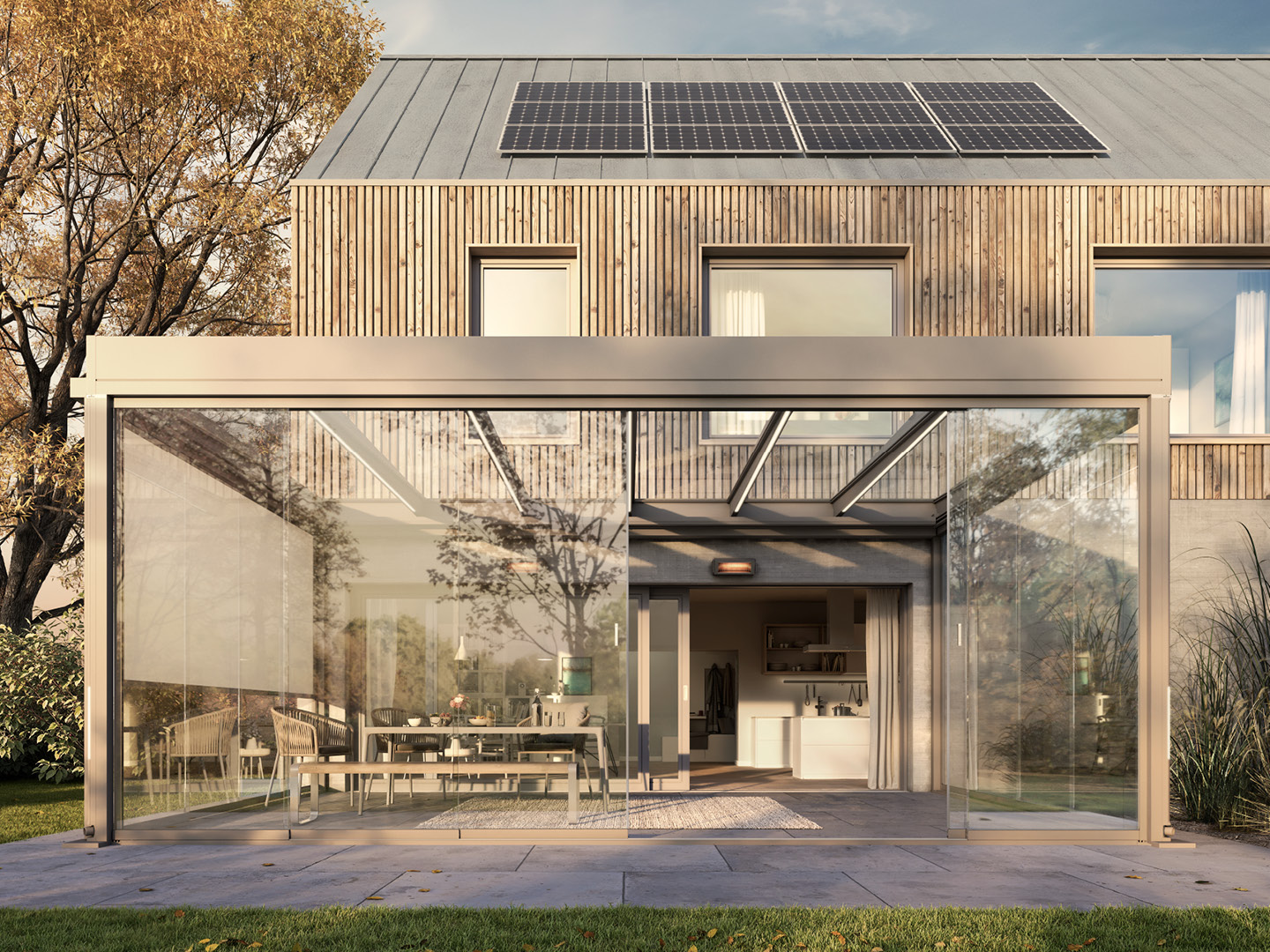
Guttering Built Into the Frame or Added as a Separate Component
A veranda or glass room roof needs to shed water safely away from the house. Some systems have guttering built into the frame (integrated); others have a separate gutter that bolts on after the frame is up. The choice affects appearance, cost, and how well water is managed. This page compares them.
Safety first: isolate power before touching a motorised system, and never work at height off a ladder alone. If in doubt, book a fitter rather than forcing a mechanism.
Integrated Guttering: Designed Into the Frame, Cleaner Look
Integrated gutters are channels built into the frame profile, the top edge of the upright post or the outer edge of the roof member has a gutter shape that sheds water. Water running down the roof flows into this channel and runs along the frame itself. The advantage is clean appearance: there's no separate component bolted on the outside, so the veranda looks sleek and purposeful. The disadvantage is that the gutter is narrow (limited by the frame profile size), so it can only handle a certain amount of water. In heavy rain, the gutter might fill and overflow. Also, debris (leaves, twigs) can collect inside the integrated channel and block water flow, requiring cleaning every spring.
Separate Guttering: Larger Capacity, More Visible, Reliable
Separate guttering is a standard rain gutter, the kind used on houses, bolted to the outside of the veranda or glass room frame. Because it's a standard component, it comes in various sizes (typically 100-150mm wide), so you can choose capacity appropriate to your roof area and local rainfall. The downside is visibility: it's an extra component bolted on, visible from the street or garden. But that extra visibility is associated with extra capacity and reliability, a proper gutter rarely overflows and handles debris better than an integrated channel.
Rainfall Intensity and Roof Area: When Size Matters
A roof 4 metres wide and 3 metres deep has about 12 square metres of surface. In Yorkshire, a 1-in-5-year storm (heavy rainfall) can deliver 40-50mm of rain in an hour. That's roughly 500 litres of water hitting the roof in 60 minutes, all flowing toward the gutter. A standard 100mm gutter handles this; an integrated channel might not. If the veranda is large or in a high-rainfall area (Pennine foothills, moorland), a separate gutter is often advisable. If it's a modest pergola in a sheltered suburban garden, integrated might be adequate.
- Integrated gutter: 15-25mm capacity, suitable for small structures
- Separate gutter: 50-100mm capacity, suitable for all sizes
- Integrated gutter: limited by frame profile size
- Separate gutter: can be sized to the specific rainfall load
Blockage, Debris and Annual Maintenance
Any gutter blocks in autumn when leaves fall. An integrated gutter, being narrow and inside the frame, is harder to clean, you can't easily stick a hand in to pull out debris. A separate gutter, sitting proud of the frame, is easier to access and clean. In gardens surrounded by trees, maintenance is an annual task. An integrated system in the same location becomes frustrating. Flowing water behind the gutter (between it and the wall or frame) can cause problems that you can't see until there's damage.
Cost Difference and Installation Impact
Integrated guttering is usually built into the frame design, so there's no separate line item, it's part of the frame you're already paying for. Separate guttering is an add-on, with the price depending on the length and material (aluminium is standard, copper is premium and costs noticeably more). However, integrated guttering that's inadequate might need supplementing with a separate gutter anyway, negating the initial saving. Get a rainfall calculation for your site: if the roof area and local rainfall indicate you need larger capacity than the integrated gutter provides, plan for a separate system from the start.
Questions we get asked on repair calls
Can you add a separate gutter to a veranda that was built with only integrated guttering?
Yes. You can bolt a gutter to the outer edge of the frame. It's an addition to the original design but entirely feasible and not expensive.
Do integrated gutters ever cause water to run down the outside of the frame?
If they're narrow and rainfall is heavy, yes. The gutter fills faster than the water flows along it, and it overflows onto the frame exterior. This is a key reason some people prefer separate guttering.
How often should gutters be cleaned, and what does it cost?
Typically twice a year (spring and autumn) in gardens with trees; once a year in open areas. If you hire someone for professional cleaning, get a written quote based on your specific gutter length and complexity.
Is aluminium gutter always used, or are other materials available?
Aluminium is standard for modern structures. Copper and steel gutters exist but are rarely used on new buildings because of cost. Aluminium is durable and lightweight.
What happens if the integrated gutter leaks where it meets the frame?
Leaks at the gutter seal can let water run down the inside of the frame. If this happens, it's usually a sealant failure that can be repaired by an installer, though access inside the frame is sometimes difficult.
Deciding Between Integrated and Separate for Your Site
Ask your installer: what's the rainfall intensity for your postcode and property, and does the frame's integrated guttering have the capacity for that? If yes, integrated is neater and cheaper. If no, separate is more reliable. Also consider access: can the integrated gutter be easily cleaned by you or someone hired? In a garden with trees (which means leaves and debris), separate guttering is usually the better choice because it's maintainable. In an open, sheltered suburban garden, integrated might be fine.
In short
Integrated guttering is neater but has limited capacity and is harder to maintain. Separate guttering is visible but handles heavy rain better and is easier to clean and access.
Get it looked at
Wondering whether your veranda roof should have guttering built into the frame or a separate system bolted on? We'll assess your roof area and local rainfall, and recommend the arrangement that won't overflow or block when you need it.
Ready to Transform Your Outdoor Space?
Get a free, no-obligation quote. Email a photo of the area plus your preferred width, projection and operation type, and we'll do the rest.